
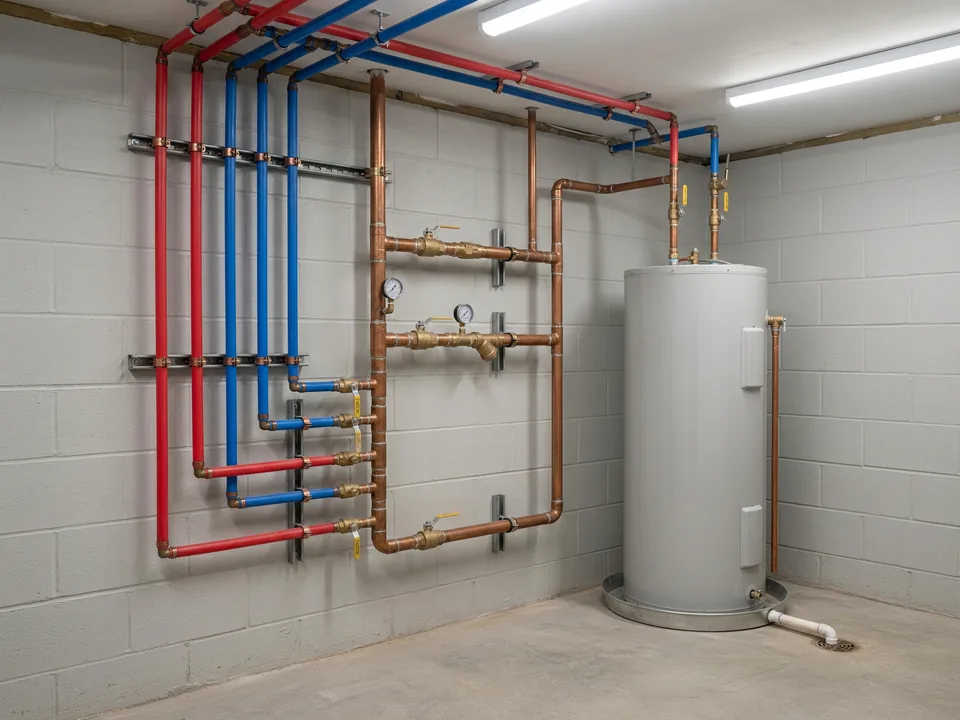
To prevent frozen and burst pipes in Saratoga Springs and Utah County, disconnect all outdoor garden hoses before the first autumn freeze, insulate supply lines in unheated garages and crawlspaces, keep indoor thermostats at 55°F or higher when traveling, and open sink cabinets along exterior walls whenever overnight temperatures drop into the single digits.
Every winter across northern Utah County, Arctic cold fronts sweep across Cedar Pass and Utah Lake, plunging overnight temperatures into the single digits or below zero. Water expands by roughly 9% when it freezes inside a pipe—generating thousands of pounds of hydraulic pressure that splits copper fittings, cracks brass hose bibbs, and ruptures PEX manifolds the moment temperatures thaw.
If a pipe has already burst in Eagle Mountain, Wildflower, Harvest Hills, or Lehi, shut off your main water valve immediately and call our Saratoga Springs water damage restoration referral line at (801) 555-0194 for rapid burst pipe water damage mitigation and emergency water extraction.
Where Pipes Freeze Most Often in Saratoga Springs & Utah County Homes
| High-Risk Plumbing Zone | Why It Freezes Locally | Prevention Upgrade |
|---|---|---|
| Exterior Frost-Free Hose Bibbs | Leaving a garden hose attached traps water inside the stem, splitting the copper pipe inside your finished basement ceiling. | Disconnect all hoses by October 15 and snap insulated foam faucet covers over every exterior spigot. |
| Garage Mechanical Walls & Water Softeners | Opening 3-car garage doors repeatedly on sub-zero mornings blasts cold air across uninsulated PEX loops and softener brine lines. | Wrap exposed garage lines with closed-cell foam pipe insulation and seal air leaks around garage door weatherstripping. |
| Exterior-Wall Kitchen & Bath Sinks | Closed cabinet doors block warm room air from reaching supply lines routed against north- or west-facing exterior walls. | Crack vanity and sink cabinet doors open overnight when Utah County forecasts drop below 15°F. |
| Basement Rim Joists & Crawlspaces | Unsealed rim-joist cavities let freezing wind from Lake Mountain chill overhead supply lines feeding main-floor bathrooms. | Air-seal and insulate rim-joist bays with rigid foam board and fire-rated spray foam. |
| Secondary Irrigation Backflow & Manifolds | Trapped water in above-ground vacuum breakers cracks brass bodies over winter, flooding foundations during spring startup. | Blow out pressurized secondary irrigation zones thoroughly every autumn before the first hard freeze. |
PEX vs. Copper Plumbing: Does PEX Still Burst in Utah Winters?
Many newer homes in Wildflower, Northshore, and Legacy Farms use cross-linked polyethylene (PEX) supply tubing instead of rigid copper. While PEX can expand modestly to tolerate brief freezes better than copper, PEX is not freeze-proof. Prolonged sub-zero exposure still splits PEX walls—and even more commonly, ice expansion cracks the rigid brass or poly-alloy crimp fittings, shutoff valves, and plastic toilet supply nuts attached to PEX lines. Treat PEX plumbing with the exact same winter cold-snap precautions as copper.
What to Do Safely If You Suspect a Frozen Pipe (Before It Bursts)
- Turn On the Faucet Served by the Frozen Line: Opening the faucet relieves internal hydraulic pressure as ice begins melting and lets you see immediately when flow returns.
- Locate Your Main Shutoff Valve First: Before applying any warmth, confirm where your main quarter-turn shutoff valve is so you can stop water in seconds if a split opens up as the ice melts.
- Apply Gentle, Controlled Heat Only: Use a hair dryer, warm wet towels, or a small UL-listed space heater kept safely away from combustibles. Warm the pipe gradually starting closest to the open faucet and working back toward the frozen section.
- Never Use Open Flames: Propane torches, heat guns on high settings, and kerosene heaters ignite drywall paper and wood framing every winter—and can melt PEX tubing instantly.
- Call a Plumber & Mitigation Crew Immediately If You Spot Water: If drywall dampens or water sprays when the pipe thaws, close the main valve and call (801) 555-0194 right away so clean Category 1 water is extracted before it saturates subfloors and requires drywall flood cuts.
Winter Vacation & Vacant-Home Checklist for ZIP 84045
Heading out of town for the holidays or winter break? Protect both your home and your Utah insurance coverage (since many policies exclude freeze losses in unheated vacant homes—see our Utah insurance claims guide):
- Keep your furnace thermostat set no lower than 55°F–60°F (and verify your furnace filter is clean before leaving).
- Shut off your main indoor water supply valve and open the lowest basement faucet briefly to relieve line pressure—or rely on an automatic smart shutoff valve (see smart leak prevention options).
- Ask a trusted neighbor to check your home visually after major snowstorms or sub-zero snaps.
- Check your water heater's vacation mode setting and confirm its drain pan is clear.
If winter freezing has already damaged your basement or ceilings, estimate potential mitigation costs using our Saratoga Springs cost calculator or learn how commercial crews restore wet framing in our structural drying timeline guide.
Room-by-Room Pre-Winter Freeze Audit for Saratoga Springs Homes
Before northern Utah County hits its first sustained sub-20°F cold snap in late autumn, walk your home with a flashlight and check these six locations—most take less than 20 minutes to winterize and prevent thousands of dollars in burst pipe water damage:
| Location to Inspect | What to Look For | Quick Fix Before Freezing Nights |
|---|---|---|
| All Exterior Spigots (Front, Side & Backyard) | Attached garden hoses, splitters, or dripping stems. | Disconnect every hose and splitter; drain residual water; snap insulated foam covers tightly against stucco or siding. |
| Main Culinary Shutoff Valve | Stiff gate valves or hidden access behind storage shelves. | Exercise the quarter-turn ball valve once, tag it brightly so every adult can find it, and clear storage boxes away. |
| Garage Wall Plumbing & Water Softener | Bare copper/PEX stubs near the garage door track or uninsulated attic hatch. | Install snug foam pipe sleeves, seal gaps around garage door bottom weatherstripping, and keep garage doors closed promptly. |
| Basement Ceiling Above Walkout Doors | Cold air drafts sneaking around rim joists near patio headers. | Seal rim-joist cracks with caulk or rigid foam board; keep basement heat registers open all winter. |
| Secondary Irrigation Backflow Preventer | Water left inside the brass bell housing or vertical risers. | Shut off the secondary curb valve, open test cocks and drain plugs at a 45° angle, and blow out all zones completely. |
| Under-Sink Exterior Wall Cabinets | Cold drafts entering around drain-pipe wall penetrations. | Seal around PVC drain cutouts with expanding foam and leave cabinet doors cracked open on sub-zero nights. |
What Happens Inside Your Walls the Moment a Frozen Pipe Thaws?
Homeowners are often confused when a pipe bursts on a sunny afternoon after temperatures climb back above freezing. Ice itself acts as a temporary plug inside the split copper or PEX wall while temperatures remain sub-zero. The moment daytime warmth melts that ice plug, full 60–80 PSI municipal water pressure blasts out through the fracture—pouring up to 4 to 8 gallons per minute into ceiling joists, recessed light cans, and basement drywall.
That is why knowing your main shutoff valve location—and calling (801) 555-0194 immediately for emergency water extraction and structural drying—turns a potential multi-room tear-out into a fast, controlled clean-water recovery.
Smart Freeze-Prevention Upgrades for Saratoga Springs & Eagle Mountain Homes
If your home sits on an exposed windward lot near Cedar Pass in Eagle Mountain or western Wildflower, three modest upgrades dramatically reduce winter pipe-burst risk year after year. First, install frost-free sillcocks pitched slightly downward toward the exterior so water drains out automatically every time you turn off the valve. Second, place battery-powered Wi-Fi temperature and moisture sensors inside unheated garage utility closets and crawlspaces set to alert your phone if temperatures dip below 40°F. Third, consider an inline ultrasonic smart shutoff valve on your main culinary line—which shuts off household water automatically if an unseen line splits while you are away from home, preventing catastrophic basement flooding. Pairing those three upgrades with an annual autumn blow-out of your pressurized secondary irrigation lines gives Utah County homeowners dependable protection through the coldest January stretches.
Frequently Asked Questions
At what outdoor temperature do pipes start freezing in Saratoga Springs, UT?
Does letting a faucet drip actually prevent burst pipes?
Why did my outdoor hose bibb leak inside my basement in April instead of January?
Need Local Water Mitigation Help in ZIP 84045?
Call (801) 555-0194 any hour to connect with an independent local water damage restoration contractor serving Saratoga Springs, Eagle Mountain, and Lehi.
Call (801) 555-0194 — 24/7 Dispatch