
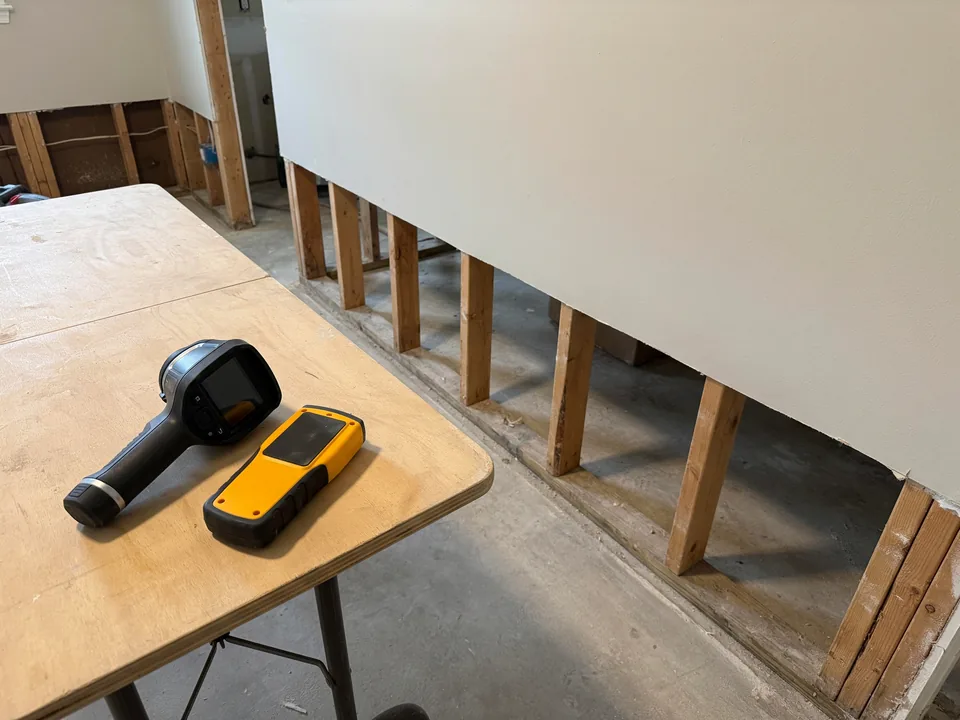
Drywall can sometimes be dried in place after a clean Category 1 supply-line leak when walls contain no wet fiberglass insulation and commercial dehumidification starts immediately. A 12-inch to 24-inch drywall flood cut is necessary whenever water is Category 2 or 3, fiberglass batt insulation is soaked, or double-layer vapor barriers trap moisture inside stud bays.
Watching a restoration technician score a neat horizontal line two feet up your freshly painted basement wall can feel alarming—especially if the drywall only looks damp along the bottom inch. Yet knowing when a drywall flood cut is strictly required versus when walls can safely be dried in place separates thorough, mold-free mitigation from costly shortcuts.
If your walls have absorbed water in Wildflower, Legacy Farms, Northshore, or Eagle Mountain, call our Saratoga Springs water damage restoration line at (801) 555-0194 to connect with an independent technician who uses thermal imaging and moisture meters—not guesswork—to evaluate every wall cavity.
Drywall Flood Cut vs. Drying in Place: Decision Matrix
| Condition Inside the Wall | Recommended Approach | Technical Reason |
|---|---|---|
| Category 1 clean water, interior uninsulated partition wall, fast response | Dry in Place (remove baseboard, drill weep/vent holes if needed) | Clean gypsum dries cleanly without losing strength when cavity humidity drops rapidly via LGR dehumidification. |
| Category 1 clean water, exterior insulated basement wall (wet fiberglass batts) | 12"–24" Flood Cut | Soaked fiberglass insulation slumps and holds water against wood studs and concrete for weeks, triggering hidden mold. |
| Category 2 gray water (sump/appliance) contacting lower drywall | 12"–24" Flood Cut | Contaminated water wicks into paper backing where surface sprays cannot sanitize behind the board. |
| Category 3 black water (sewage or storm runoff) | Mandatory Flood Cut (12"–24" above high-water line) | IICRC S500 requires porous removal and structural disinfection of exposed studs and sill plates. |
| Vinyl wallpaper, gloss paint, or vapor-retarding finishes on wet drywall | Flood Cut or Cavity Injection | Impermeable wall coverings trap moisture inside the gypsum core, stalling normal surface evaporation. |
The Physics of Capillary Wicking in Gypsum Drywall
Drywall is a gypsum core sandwiched between two layers of cellulose paper—essentially a vertical sponge. Even when standing water on a basement slab is only 1 inch deep, capillary action pulls moisture 8 to 16 inches upward inside the drywall within hours. That paper backing is also the primary food source for household mold once wood and gypsum remain damp beyond 24 to 48 hours.
Because water travels hidden behind baseboards and inside wall cavities, visual inspection alone is unreliable. Independent crews rely on handheld infrared thermal cameras (which spot evaporative cooling patterns inside stud bays) paired with penetrating pin meters to measure exact moisture percentages before deciding whether to cut.
Why 24-Inch or 48-Inch Cuts Actually Save Money During Rebuild
Homeowners sometimes ask contractors to cut only the bottom 4 or 6 inches of wet drywall to "save material." Ironically, narrow cuts almost always cost more to rebuild and look worse once painted. Standard drywall sheets measure 4 feet by 8 feet (48 inches tall). Cutting a crisp, level 24-inch flood cut allows your drywall finisher to rip a single 4-foot sheet cleanly in half lengthwise with minimal waste, tape one straight horizontal seam, and match texture seamlessly—whereas a cramped 6-inch strip forces awkward taping right above the baseboard and hides wet insulation higher in the stud bay.
What Happens Behind the Wall After a Flood Cut?
- Wet Insulation Removal: Soaked fiberglass batts are pulled and bagged immediately so airflow reaches the exterior concrete foundation wall and wood studs.
- Antimicrobial Framing Wash: For sewage backup cleanup or storm flood restoration, exposed studs and bottom sill plates are cleaned and treated with EPA-registered disinfectants.
- Direct Structural Drying: High-velocity air movers sweep dry LGR air directly across the exposed wood framing, cutting total structural drying time significantly (see structural drying timelines).
- Moisture Verification Before Re-Closing: Wood studs and sill plates are metered daily until readings return to Utah's normal dry baseline (~10%–14%) before new insulation and drywall go back up.
Does a Drywall Flood Cut Require a Saratoga Springs Permit?
Removing damaged lower drywall for emergency drying and hanging like-for-like replacement sheetrock without altering framing, electrical circuits, or plumbing generally does not require a city permit. If submerged outlets, switches, or framing studs must be replaced, check our Saratoga Springs building permits guide before closing the walls, and explore ballpark mitigation ranges in our cost calculator.
Step-by-Step: How Independent Crews Execute a Clean, Rebuild-Ready Flood Cut
When moisture meters and water-category rules confirm that drywall must be opened in a Saratoga Springs, Eagle Mountain, or Lehi basement, professional mitigation crews follow a disciplined sequence designed to control dust, protect wiring, and keep your future drywall rebuild affordable:
- Score Caulk Lines & Remove Baseboards Carefully: Solid wood or painted MDF baseboards are pried off after scoring the top caulk bead so upper drywall paper does not tear. Undamaged solid wood trim can sometimes be dried and reused; swollen MDF trim is discarded.
- Map the Exact Moisture Line with a Pinless Meter: Technicians trace upward along every stud bay to verify the highest point of capillary wicking—then snap a straight chalk line uniformly at 24 inches (or 48 inches if floodwater rose above 20 inches) around the affected walls.
- Check Electrical Outlets & Shallow Cut Depth: Before running an oscillating multi-tool or rotary drywall saw, crews verify breaker shutoff and set blade depth to 1/2 inch so hidden Romex wiring and PEX supply lines behind the sheetrock are never nicked.
- Bag Wet Gypsum & Fiberglass Insulation Immediately: Saturated drywall and slumped insulation batts go straight into heavy contractor bags inside the containment zone so wet debris does not re-humidify the room or spread Category 2/3 contaminants.
- Clean Bottom Plates & Run Directed Airflow: Debris and rusted tack strips are cleared off the concrete slab, exposed wood studs and sill plates are treated with antimicrobial solution as needed, and high-velocity air movers sweep dry LGR air straight across the open framing cavities.
Comparing Cost & Mold Risk: Cutting Early vs. Waiting Too Long
| Approach | Upfront Demolition | Drying Speed | Hidden Mold Risk |
|---|---|---|---|
| Timely 24" Flood Cut (When Wet Insulation or Cat 2/3 Present) | Moderate, clean straight horizontal seam | Fast (3–4 days typical) | Very low — framing & concrete fully visible and metered dry |
| Leaving Wet Insulated Walls Closed | None initially | Slow / incomplete (weeks inside stud bays) | High — hidden mold grows behind baseboards, often forcing much larger remediation later |
| True Dry-in-Place (Clean Cat 1, Uninsulated Interior Wall Only) | Baseboard removal only | Fast (3–4 days with LGR & cavity venting) | Low when verified daily with pin meters |
If you are unsure whether your basement walls need flood-cutting after a leak, review our water damage categories guide or call (801) 555-0194 to have an independent local technician inspect your walls with a thermal camera and moisture meter before any cuts are made.
Special Wall Assemblies in Saratoga Springs Basements: Spray Foam, Rigid Board & Soundproofing
Not every finished basement wall in ZIP 84045 is built the same way. Older homes in Saratoga Shores and Harvest Hills typically use unfaced or kraft-faced fiberglass batts over concrete foundation walls—which slump and hold water immediately upon contact. Newer custom basements in Wildflower, Talons Cove, and Legacy Farms sometimes feature closed-cell spray foam, extruded polystyrene rigid foam board against the concrete, or acoustic mineral-wool insulation inside theater partition walls. Closed-cell foam resists water absorption far better than fiberglass, yet standing water can still pool along the bottom sill plate behind the drywall face. That is why independent technicians always verify bottom-plate moisture with a penetrating pin meter before signing off on any wall—whether cut or dried in place—after flooded basement cleanup or burst pipe water damage. Taking five minutes to review those moisture readings with your technician before reconstruction protects your finished basement investment for the long term.
When your walls are verified dry and ready for put-back, matching the light orange-peel or knockdown drywall texture common across Saratoga Springs subdivisions is straightforward on a clean 24-inch horizontal seam. Ask your drywall finisher to feather joint compound 10 to 12 inches above the cut line and prime with a stain-blocking primer before repainting corner-to-corner so the repair disappears completely.
Frequently Asked Questions
How high should a drywall flood cut be after a basement flood?
Can you dry fiberglass insulation inside a wall without removing the drywall?
What if my drywall only got wet from a clean burst pipe upstairs?
Need Local Water Mitigation Help in ZIP 84045?
Call (801) 555-0194 any hour to connect with an independent local water damage restoration contractor serving Saratoga Springs, Eagle Mountain, and Lehi.
Call (801) 555-0194 — 24/7 Dispatch